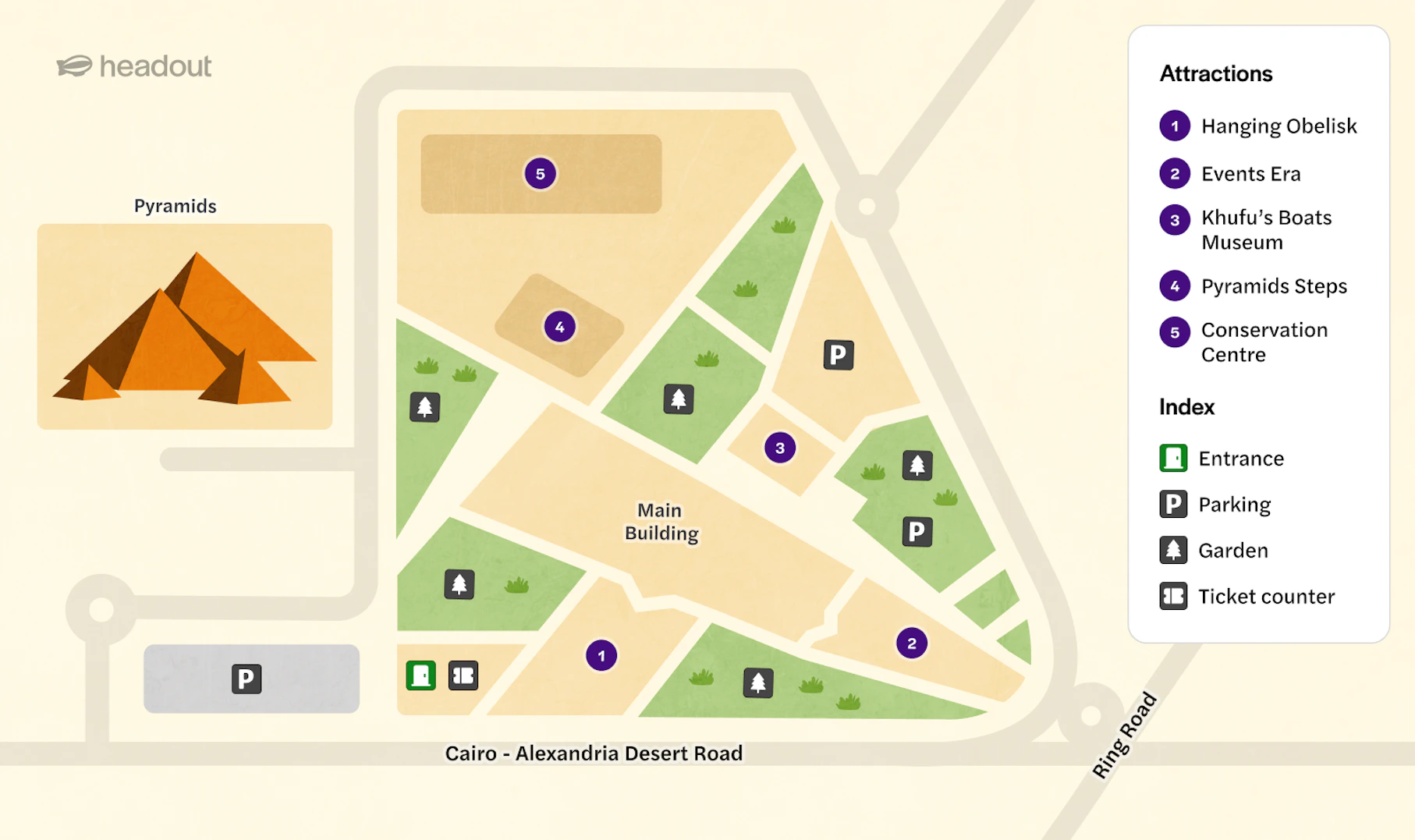
- Arrival and parking: If you’re arriving via the Cairo–Alexandria Desert Road, look for the parking lot on the left side of the main entrance road. Additional parking areas are located on the eastern side of the complex, near the Ring Road intersection.
- Tickets and main entrance: Head to the main entrance area off the Cairo–Alexandria Desert Road. Locate the ticket counter before proceeding through the entrance gate.
- Front courtyard: The Hanging Obelisk (1) stands in the entry plaza just beyond the main gate. Follow the southern pathway to the right to reach the Events Plaza (2).
- Main building and Khufu’s Boats Museum: Follow the central path from the entrance to the Main Building. Khufu’s Boats Museum (3) is located behind it, towards the upper-right side of the grounds.
- Pyramids Steps and Conservation Centre: Continue north past the garden walkways to reach the Pyramids Steps (4), then proceed further north towards the Conservation Centre (5).
- Views of the pyramids: The northwestern edge of the grounds offers views towards the Giza Pyramids complex.
Check out the Grand Egyptian Museum maps before your visit
Navigate the Grand Egyptian Museum with maps that help you plan your route before arrival and find your way around once inside. Use the exterior map to locate entrances and access points, the interior map to orient yourself around the museum, and the gallery maps to find key exhibits, including the Tutankhamun collection, Grand Staircase and Main Galleries.
Grand Egyptian Museum exterior map
Navigate the museum grounds
Download the Grand Egyptian Museum exterior map to get your bearings around the site and locate key outdoor areas before you arrive.
Getting around the Grand Egyptian Museum grounds
Grand Egyptian Museum interior map
Find your way around the museum
Download the Grand Egyptian Museum interior map to navigate its floors, locate key exhibits and galleries, and find essential visitor facilities before you begin your visit.
Navigating your way around the Grand Egyptian Museum interior
Use the Grand Egyptian Museum interior map to navigate the galleries, find essential facilities and plan your route between levels. Start at the Grand Hall, follow the Grand Staircase to the upper floors, and use the map to locate the Tutankhamun Galleries, Main Galleries and other key stops.
Start at the Main Entrance, where you’ll find an Information Desk, Tour Earphones Desk, restrooms and an ATM. Walk straight into the Grand Hall to see the Colossal Statue of Ramesses II (1).
- Key statues: Follow the central path to find the Victory Column of Merenptah (2), Ptolemaic King and Queen Statues (3) and Senusret Statues (4).
- Visitor facilities: At the top-right of the Grand Hall, you’ll find the prayer room, restrooms, lifts and wheelchair-accessible routes.
- Glass Hall: Continue towards the far right of the building to find the Ramesses II Statue from San el-Hagar (5), another Information Desk, restrooms, and the main retail and dining area.
From the Grand Hall, turn left to reach the Grand Staircase and follow the route towards the first floor.
- Temporary Exhibition (6): Located near the bottom-left of the staircase.
- Sakkara Canon (7): Look for this landmark along the first section of the staircase.
- Mixed Reality Hall (8): Find it on the first floor, with restrooms nearby.
- Step-free access: Lifts and wheelchair-accessible routes run alongside the staircase.
- Continue past the top of the Grand Staircase to reach the Children’s Museum (9) on the second floor.
Head to the third floor to explore the museum’s major exhibition spaces.
- Tutankhamun Galleries (10): Head towards the far northwestern corner to see treasures from the king’s tomb.
- Main Galleries (11): Follow the map towards the far western wing to explore artefacts from ancient Egyptian history.
- Finding your way back: An Information Desk and lift are available in the western gallery hub.
Grand Egyptian Museum Main Galleries map
Plan your route through the main galleries
Use the Grand Egyptian Museum Main Galleries map to navigate the exhibition spaces, locate key displays, and plan which galleries to visit during your time at the museum.
Navigating the main galleries
The Main Galleries are arranged across 12 halls, with three thematic avenues intersecting four historical periods. Enter beside Hall 01 at the bottom-left corner of the map, then choose to explore the galleries chronologically or follow one theme across different eras.
- 3 themes: Society, Kingship, and Beliefs.
- 11 historical periods: From Prehistoric and Predynastic Egypt to the Graeco-Roman period.
- 12 halls: Each hall explores a different intersection of theme and historical period.
- Entrance and exit: Both are located beside Hall 01, at the bottom-left corner of the map.
Explore the main galleries in the order that suits your interests. Follow the timeline to move through history or focus on one theme across different periods.
Chronological Route
Follow history, period by period. Move across each row from left to right, starting with Egypt’s earliest history and ending with the Graeco-Roman period.
- Early history: Hall 01 (Society) → Hall 02 (Kingship) → Hall 03 (Beliefs). Covers Prehistoric, Predynastic, Early Dynastic, Old Kingdom, and First Intermediate Period.
- Middle history: Hall 06 (Society) → Hall 05 (Kingship) → Hall 04 (Beliefs). Covers the Middle Kingdom and Second Intermediate Period.
- New Kingdom: Hall 07 (Society) → Hall 08 (Kingship) → Hall 09 (Beliefs).
- Late and foreign rulers: Hall 12 (Society) → Hall 11 (Kingship) → Hall 10 (Beliefs). Covers the Third Intermediate, Late, and Graeco-Roman periods.
Thematic Route
Explore one theme across the ages. Follow a column through the four historical rows to trace changes in ancient Egyptian society, kingship, or religious beliefs over time.
- Society: Halls 01 → 06 → 07 → 12. Explore daily life, social structures, technology, and trade.
- Kingship: Halls 02 → 05 → 08 → 11. Focus on pharaohs, state power, and military history.
- Beliefs: Halls 03 → 04 → 09 → 10. Explore religion, deities, rituals, and the afterlife.
Visitor facilities at the Grand Egyptian Museum
The Grand Egyptian Museum offers essential facilities to help you stay comfortable, take breaks, and make the most of your visit.
- Information desks: Get help with visitor queries, ticket-related questions, and planning your visit.
- Accessibility: Wheelchair-accessible routes and lifts help visitors with reduced mobility navigate the museum.
- Restrooms: Restroom facilities are available throughout the museum for convenient access during your visit.
- Prayer room: A dedicated space is available for visitors who need a quiet place to pray.
- Dining and shopping: Take a break between galleries with food and drink options, or browse the museum shops for souvenirs, books, replicas, and gifts.
- ATM: Access cash during your visit if needed.
- Tour earphones: Collect earphones for an audio tour (extra cost).
- Medical assistance: A clinic is available if you need medical attention during your visit.
Tips for your visit
- Book your tickets in advance: Choose your ticket type before arriving, especially if you want a guided tour or hotel transfers.
- Arrive early: The galleries open after the museum complex, so plan your arrival around gallery opening time to make the most of your visit.
- Allow enough time: The museum has multiple exhibition areas, including the Main Galleries and Tutankhamun Galleries. Prioritize the sections you most want to see.
- Plan your gallery route: Use the Main Galleries map to choose between a chronological route and a thematic route focused on Society, Kingship, or Beliefs.
- Start with the highlights: Visit popular displays early in your visit, then explore the remaining galleries at your own pace.
- Check your ticket inclusions: Guided tours, transfers, and other extras vary by ticket, so confirm what’s included before booking.
- Carry your ID and ticket: Keep your booking confirmation and required identification handy for entry.
- Dress for walking: Wear comfortable shoes, as exploring the museum’s galleries and grounds involves walking.
- Keep entry rules in mind: Outside food and drinks, drones, tripods, selfie sticks, and flash photography are not permitted.
- Save time for a break: The museum has dining and shopping facilities, so you can pause for refreshments or browse souvenirs during your visit.
Frequently asked questions about Grand Egyptian Museum maps
The Main Galleries span 12 halls arranged around three themes: Society, Kingship, and Beliefs. These cover 11 historical periods, grouped into four rows. You can follow a chronological route across each row or explore one theme at a time.
Your visit length depends on how many galleries and exhibits you want to see. Allow enough time for the main galleries and Tutankhamun Galleries, and factor in additional time for other exhibition spaces, breaks, and the museum grounds.
Yes. You can explore independently and use the maps to plan your route through the museum. If you prefer additional context about the exhibits, consider a guided tour if available with your ticket.
The Tutankhamun Galleries are on the third floor of the museum. You can plan your route to them alongside the Main Galleries and other exhibition spaces.
Yes. The museum has lifts and wheelchair-accessible routes to help visitors with reduced mobility navigate its levels. Check the interior map when planning a step-free route.
Choose the galleries that interest you most before arriving. The Main Galleries map lets you plan a chronological route through Egyptian history or focus on Society, Kingship, or Beliefs. You can then set aside time for the Tutankhamun Galleries if they’re a priority.


