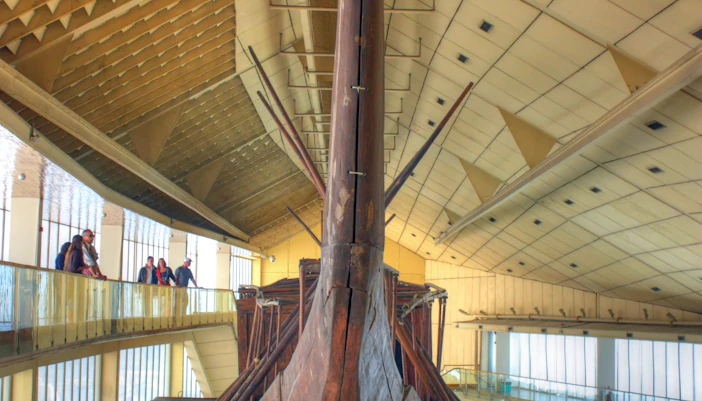
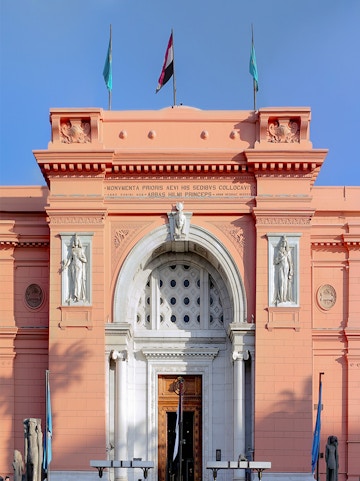
First entry on a weekday is your best bet. You’ll have a calmer gallery, cleaner sightlines along the hull, and more attention span before Cairo’s midday heat and late-morning group traffic build. Avoid treating it as an end-of-day add-on.
King Khufu's Solar Boat
Included with Grand Egyptian Museum (GEM) tickets
Timings
RECOMMENDED DURATION
5 hours
Quick overview
- Access: Included in all Grand Egyptian Museum tickets
- Separate ticket: Not required
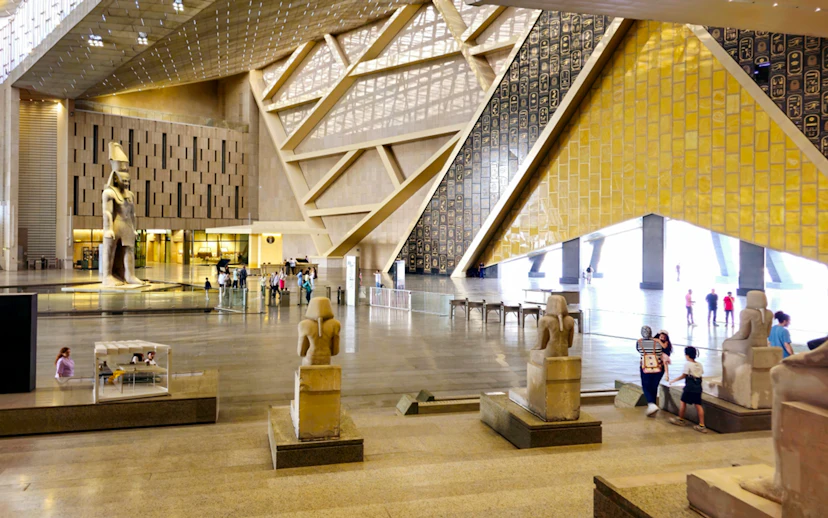
- When you’ll see it: During your Grand Egyptian Museum visit; it is not a separate open-air stop on the Giza Plateau
- Visit duration: 15–25 mins self-guided/20–30 mins with guide
- Best time: First museum entry on a weekday, before late-morning tour groups and peak afternoon heat
- Restrictions: No flash photography; tripods, selfie sticks, drones, and outside food are not allowed inside the museum

The Boat of Khufu is included with all Grand Egyptian Museum tickets. No separate ticket is needed. You see it inside the museum as part of the gallery route rather than as a standalone stop on the Giza Plateau. Book skip-the-line entry or a guided museum tour if you want a smoother entry and clearer context once you reach the vessel.
How to best experience the Boat of Khufu
Best time to visit
How long to spend
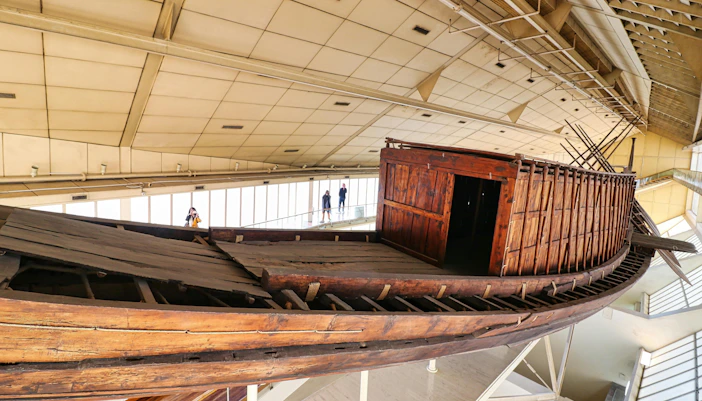
Plan 15–25 minutes on your own or 20–30 minutes with a guide. That gives you time to study the full profile, the timber construction, and the discovery context. If you rush past, it can register as only a large old boat.

Where it fits in your itinerary
Treat it as a priority stop within a 2–4 hour Grand Egyptian Museum visit. If you’re pairing GEM with the Giza Complex on the same day, give the museum a focused block rather than squeezing the boat between desert transfers.

Crowd patterns
The museum gets busier from late morning onward, especially when guided groups arrive after other Cairo stops. In a fuller room, it’s harder to step back and read the boat’s full scale. Earlier slots give you more space to move around it properly.

What to prioritize if time is short
First, step back and take in the boat’s full length. Then move closer to the hull to look at the planks, lashings, and curvature. Finish with the interpretive panels on discovery and reconstruction. Skip a lesser gallery before you skip this display.

Common mistakes to avoid
The biggest mistake is treating it as a quick photo stop and not circling it. Another is assuming the old Solar Boat Museum at Giza is still where you see it. Focus on the engineering details, not only the silhouette.
Best tickets to experience the Boat of Khufu
| Ticket type | Why choose it |
|---|---|
Skip-the-line | Reach the boat faster and keep more time for the museum galleries around it. |
Guided tour | Get the context that turns timber and scale into a real royal funerary story. |
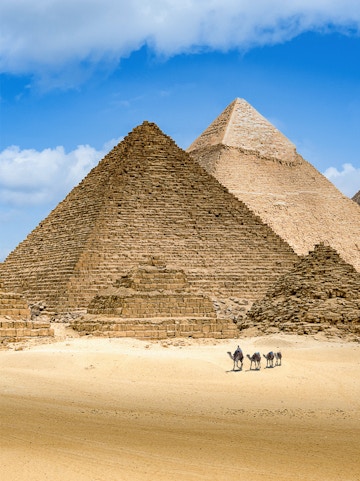
Giza + GEM combo | See Khufu’s pyramid and his boat in one plan, which makes the connection much clearer. |
Why it’s worth seeing
The Boat of Khufu is one of the few surviving objects that connects the Great Pyramid to a real piece of royal funerary equipment rather than to architecture alone. Most visitors know the pyramid, but fewer realize the vessel was found dismantled into 1,224 pieces and later rebuilt. Inside the display, don’t just admire its age. Use the viewing angles and labels to notice how ancient Egyptian builders handled scale, curvature, and joinery in wood.

The full profile: step back first
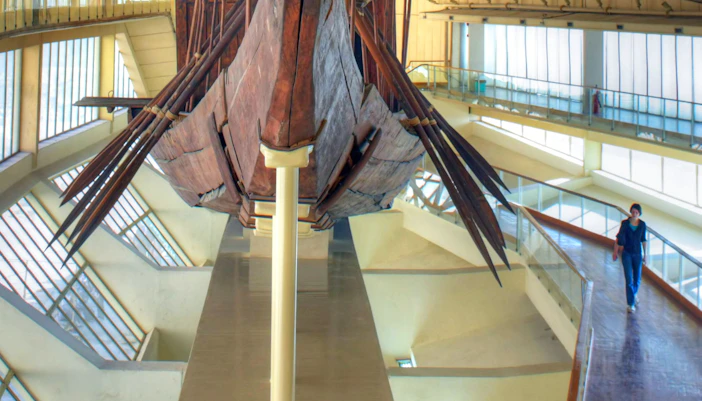
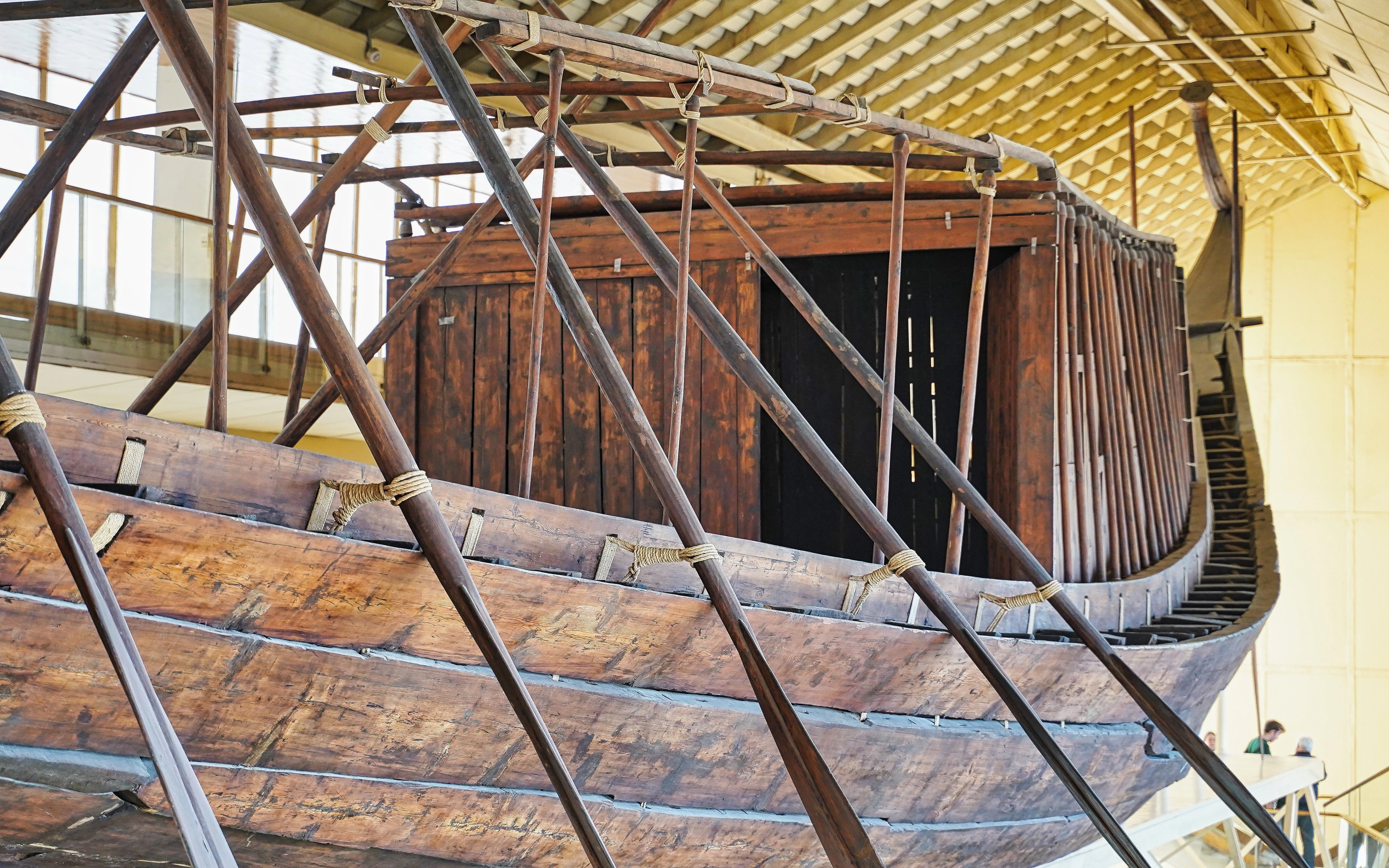
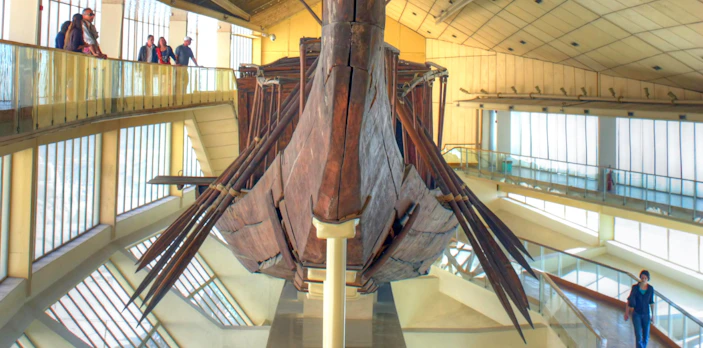
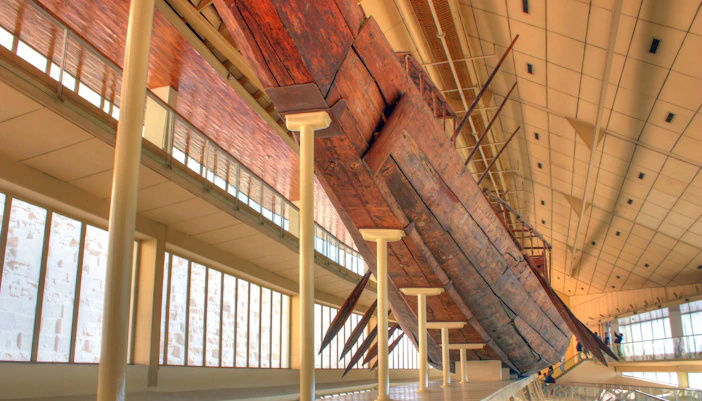
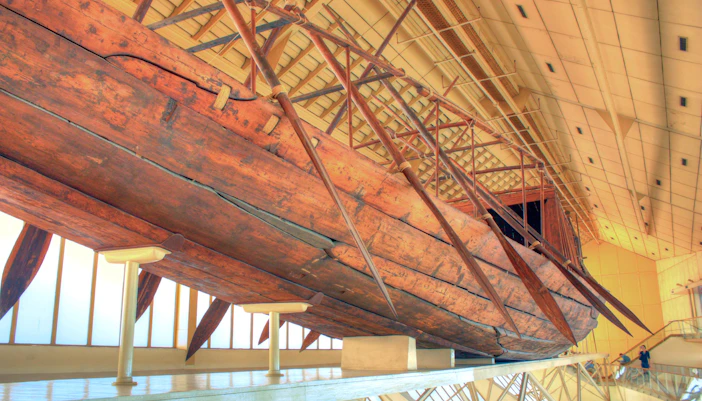
Stand at the side of the display and move far enough back to read the whole sweep from prow to stern. At more than 43m long, the vessel makes sense only at full scale. Start wide before you study any detail.

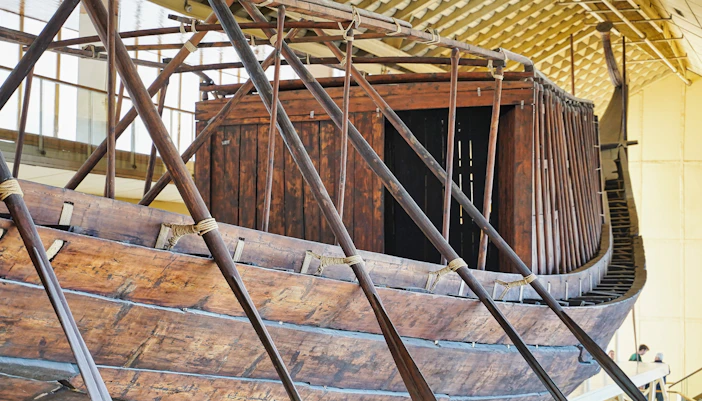
The planks and lashings: look along the hull
Move closer to the midsection and follow the joins between the wooden planks. The seams, lashings, and curves show how Egyptian craftsmen built strength and flexibility without modern metal fasteners. This is where the engineering becomes tangible.

The discovery context: read the panels before leaving
Before you move on, spend a minute with the labels explaining the sealed pit beside Khufu’s pyramid and the 1954 discovery. That context changes the boat from a museum object into part of the wider Giza funerary complex.
Historical & cultural significance
Buried for more than 4,500 years beside Khufu’s pyramid, the vessel was discovered in 1954 and dismantled into 1,224 wooden pieces. It belonged to the king’s funerary complex, where boats carried both practical and symbolic meaning in royal afterlife belief. Today, the reconstructed craft survives as one of ancient Egypt’s clearest large-scale woodworking achievements, linking the Great Pyramid to the ritual world built around it.
Notable figures
Khufu | Pharaoh
Fourth-Dynasty ruler whose pyramid complex the boat belonged to.
View Wikipedia
Kamal el-Mallakh | Archaeologist
Discovered the sealed pit containing the dismantled vessel in 1954.
View Wikipedia
Zahi Hawass | Egyptologist
Oversaw public interpretation and later relocation-era visibility for the boat.
View Wikipedia
Know before you go
- Open: Grand Egyptian Museum galleries open daily from 9am
- Close: Galleries close at 6pm on most days, and at 9pm on Saturdays and Wednesdays
- Last ticket purchase: 5pm on most days, and 8pm on Saturdays and Wednesdays
- Complex hours: The wider GEM complex opens from 8:30am
- Official source: Check the museum website before visiting, as holiday and Ramadan timings can change.
Address: Grand Egyptian Museum, Giza, Egypt
- From central Cairo: Allow about 30–45 minutes by car, depending on traffic
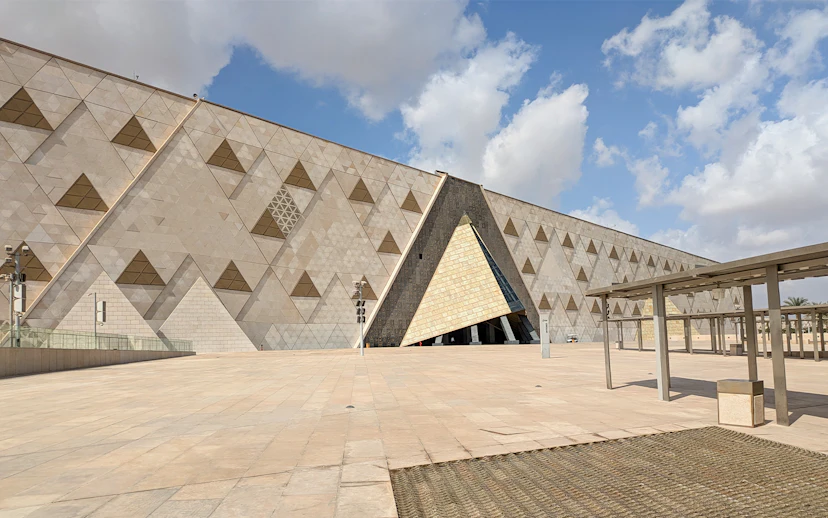
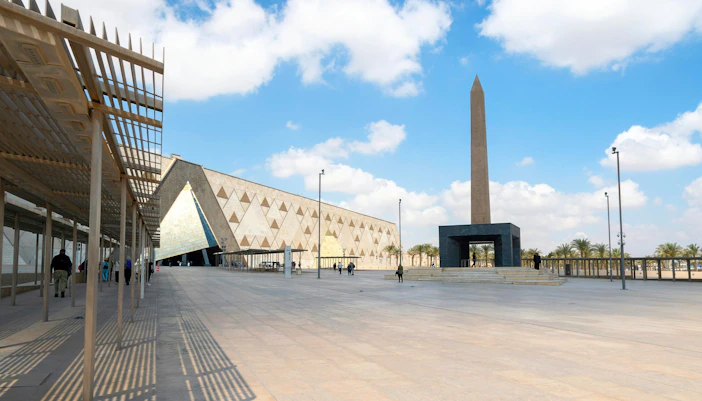
- Entry point: Enter through the Grand Egyptian Museum main entrance; the boat has no separate exterior entrance
- Inside route: Allow extra time for security and internal walking before you reach the display
- Wheelchair access: Yes; the Grand Egyptian Museum is wheelchair accessible
- Vertical access: Elevators are available between levels
- Restrooms: Accessible restrooms are available inside the museum
- Surface: Interior floors are even and climate-controlled, though the building still involves a fair amount of walking
- Family access: Prams and strollers are allowed, and staff can direct you to the easiest route
- Photography: Personal photography is allowed, but flash photography is not allowed
- Equipment: Drones, selfie sticks, tripods, and live streaming are not allowed inside the museum
- Food and drink: Outside food and beverages are not allowed
- Bags: Large bags or suitcases may be restricted and can slow security screening
- Commercial use: Commercial photography or filming requires prior written permission
Frequently asked questions about King Khufu's Solar Boat
Yes. Entry to the Boat of Khufu is included with every valid Grand Egyptian Museum ticket. No separate ticket exists.
No. Any Grand Egyptian Museum ticket gets you in. Guided tours add context, and skip-the-line entry gets you inside faster.
No. The boat has no separate entrance. You reach it only through the Grand Egyptian Museum after entering the main galleries.
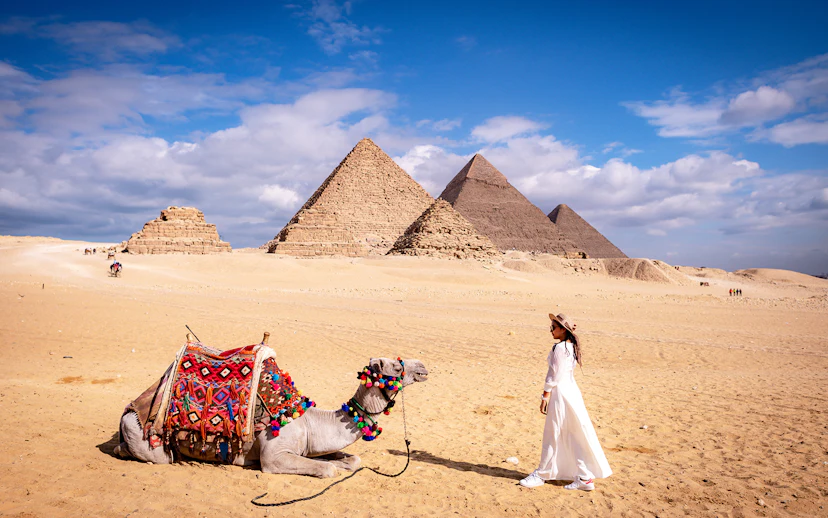
You’ll see it during your Grand Egyptian Museum route, not at the open-air Giza Plateau. Plan a museum visit of about 2–4 hours overall.
Plan 15–25 minutes self-guided or 20–30 minutes with a guide. The engineering details reward a slower look.
Yes. It’s included in guided Grand Egyptian Museum visits. A guide explains the boat’s burial context, reconstruction, and link to Khufu’s pyramid.
No. Giza Complex tickets cover the plateau and selected pyramid access. The boat is currently viewed at the Grand Egyptian Museum.
Yes. Flash photography is not allowed inside the museum. Tripods, selfie sticks, drones, and commercial filming are also restricted.
Yes. The museum is wheelchair accessible, with elevators and accessible restrooms. Expect some internal walking because the building is large.
Yes. If you care about Khufu, ancient engineering, or funerary rituals, this is one of the museum’s most specific and rewarding stops.